The Beginner's Guide to Dialling In Espresso (Training Your Team)
Stop guessing. Liam, CPO at CCS, breaks down the 'Salami Shot' technique and the difference between sour vs. bitter.
“Liam, I showed them the recipe, but the coffee still tastes different every day.”
I hear this complaint from cafe owners across Toronto and the GTA constantly. You write “18g in, 36g out” on the hopper, but the espresso still tastes like battery acid one day and burnt toast the next.
The problem isn’t the recipe. The problem is that your staff knows how to pull a shot, but not why it tastes that way.
1. The Vocabulary: Sour vs. Bitter
This is the biggest hurdle. New baristas often confuse “sour” and “bitter” because both are intense, unpleasant sensations.
- Sour (Under-Extracted): This happens when the water flows too fast. It grabs the citric acids (lemon, green apple) but misses the sugars.
- Sensation: Mouth-puckering, hits the sides of the tongue instantly.
- The Fix: Grind Finer (slow the water down) or Increase Ratio (use more water).
- Bitter (Over-Extracted): This happens when water flows too slow or uses too much water. It dissolves the woody tannins and ash.
- Sensation: Dry, chalky, lingers at the back of the throat.
- The Fix: Grind Coarser (speed the water up) or Decrease Ratio (use less water).
Note: If a shot tastes both sour AND bitter, you likely have a channeling problem. This means the puck prep was poor (uneven tamp), and water tunnelled through one spot (over-extracting it) while ignoring the rest (under-extracting it).
2. The Golden Exercise: A Basic “Salami Shot”
I don’t explain extraction theory on a whiteboard. I let them taste it. This exercise changes everything.
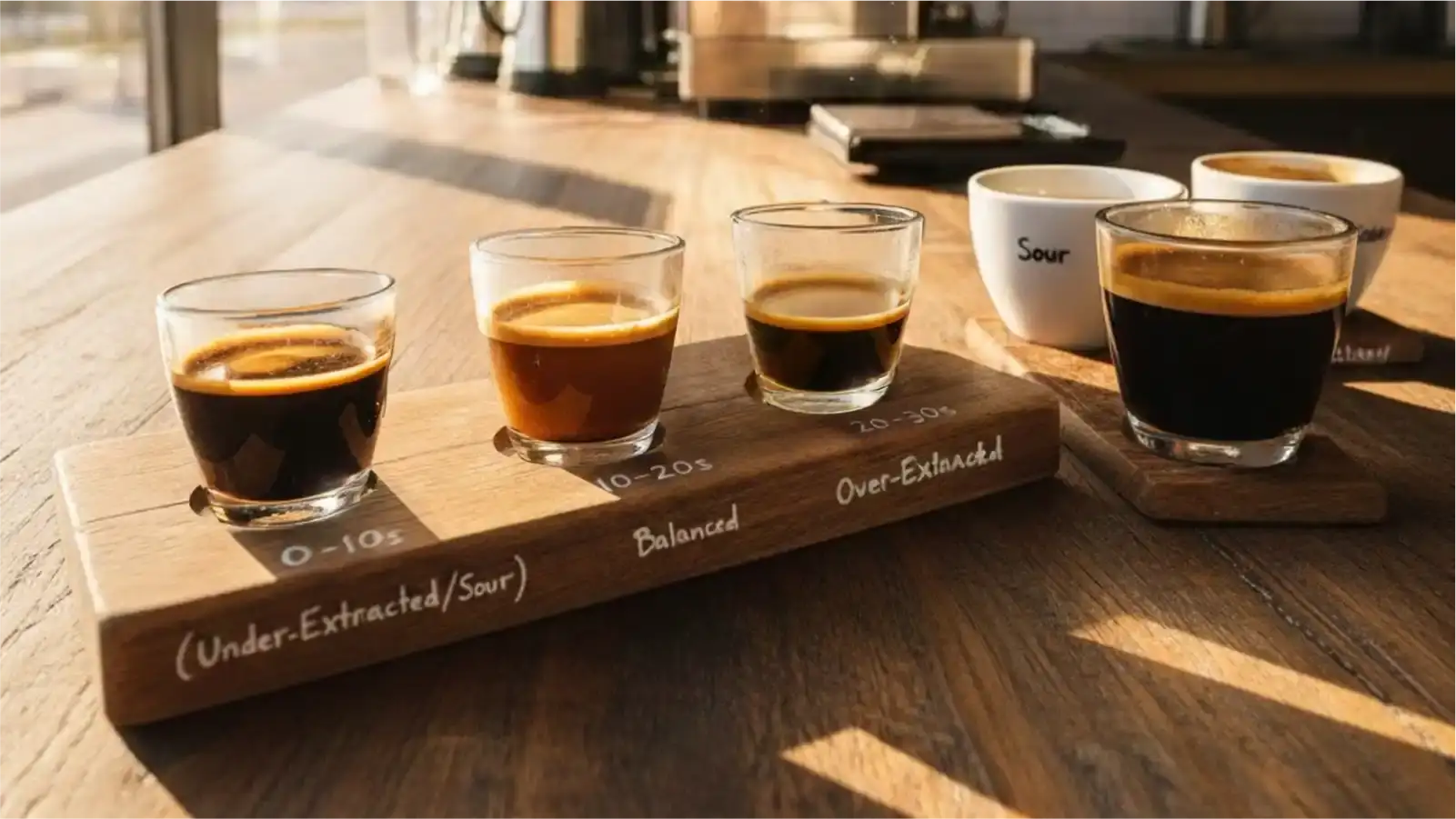
The Purpose: The purpose of a Salami Shot is to help educate your taste buds to the effect of varying brew ratio. It is not how you serve coffee.
The Process: Start a standard 30-second shot, but move a new cup under the stream every 10 seconds:
- Cup 1 (0–10 seconds): Catch the “ristretto” phase.
- Cup 2 (10–20 seconds): Catch the “normale” phase.
- Cup 3 (20–30 seconds): Catch the “lungo” phase.
The Lesson:
- Cup 1: Incredibly sour, salty, and viscous. (Under-extracted)
- Cup 2: Sweet, syrupy, and milder. (Balanced)
- Cup 3: Watery, bitter, and dry. (Over-extracted)
If you pull a regular shot that tastes like Cup 1, you know you need to increase your ratio (add more water/time). If it tastes like Cup 3, you need to decrease your ratio.
This exercise is commonly expanded to 5-6 cups at around 5-6 seconds per split. Increasing the number of samples gives you a clearer picture of the stages of extraction. But for all purposes, you can learn a lot from the 3-cup split, especially if you are new to the game.
3. The Baseline Recipe
Stop guessing. For most modern espresso blends served in Southern Ontario, start here:
- Dose: 18g (Standard double basket)
- Yield: 36g liquid espresso
- Time: 25–30 seconds
- Target Ratio: 1:2
If you hit these numbers and it tastes sour? Grind finer to push the time to 31 or 32 seconds. If you hit these numbers and it tastes bitter? Grind coarser to drop the time to 26 or 27 seconds.
4. Advanced Variables (For When You’re Ready)
Once the basics are mastered, other factors come into play:
- Temperature: Higher temps (94°C+) extract more, good for light roasts. Lower temps (90°C) reduce bitterness in dark roasts.
- Dose: Updosing (e.g., 20g in a 20g basket) increases body and intensity. Downdosing decreases body but increases clarity.
- Baskets: Precision baskets (like VST) flow faster and stricter than stock baskets.
- Pump Pressure: Lowering pressure to 6 bar or 9 bar changes the texture and reduces channeling.
Summary: Taste is King
Ultimately, dialing in is a culinary art, not just a science equation.
Your taste buds are always the guiding factor. Data points like time and weight are just tools to help you repeat a delicious result. Never feel shy to deviate from strict expectations to find a better recipe that suits your specific beans. If a 1:2.5 ratio tastes better than 1:2, use it.
Expert Takeaway
Effective barista training moves beyond ‘recipe following’ to ‘taste calibration.’ By using the Salami Shot technique, staff can physically taste the difference between under-extracted (sour) and over-extracted (bitter) compounds. Standardizing a 1:2 ratio (e.g., 18g in, 36g out) in 25-30 seconds provides a reliable baseline for consistent service in high-volume Toronto cafes.
Technical Takeaway
Effective barista training moves beyond 'recipe following' to 'taste calibration.' By using the Salami Shot technique, staff can physically taste the difference between under-extracted (sour) and over-extracted (bitter) compounds. Standardizing a 1:2 ratio (e.g., 18g in, 36g out) in 25-30 seconds provides a reliable baseline for consistent service in high-volume Toronto cafes.
Liam
Chief Product OfficerLiam leads product design and service-to-market alignment at Complete Coffee Solutions, scouting for customer needs and helping cafes and businesses make key strategic decisions. With over 12 years in the specialty coffee industry, he brings together digital design, marketing, and deep espresso expertise to keep our offerings tasty.