Water Quality: A Practical Guide for Cafe Owners
Why 98% of your espresso depends on water chemistry. Learn how to test your own water hardness and alkalinity to protect your machine investment.
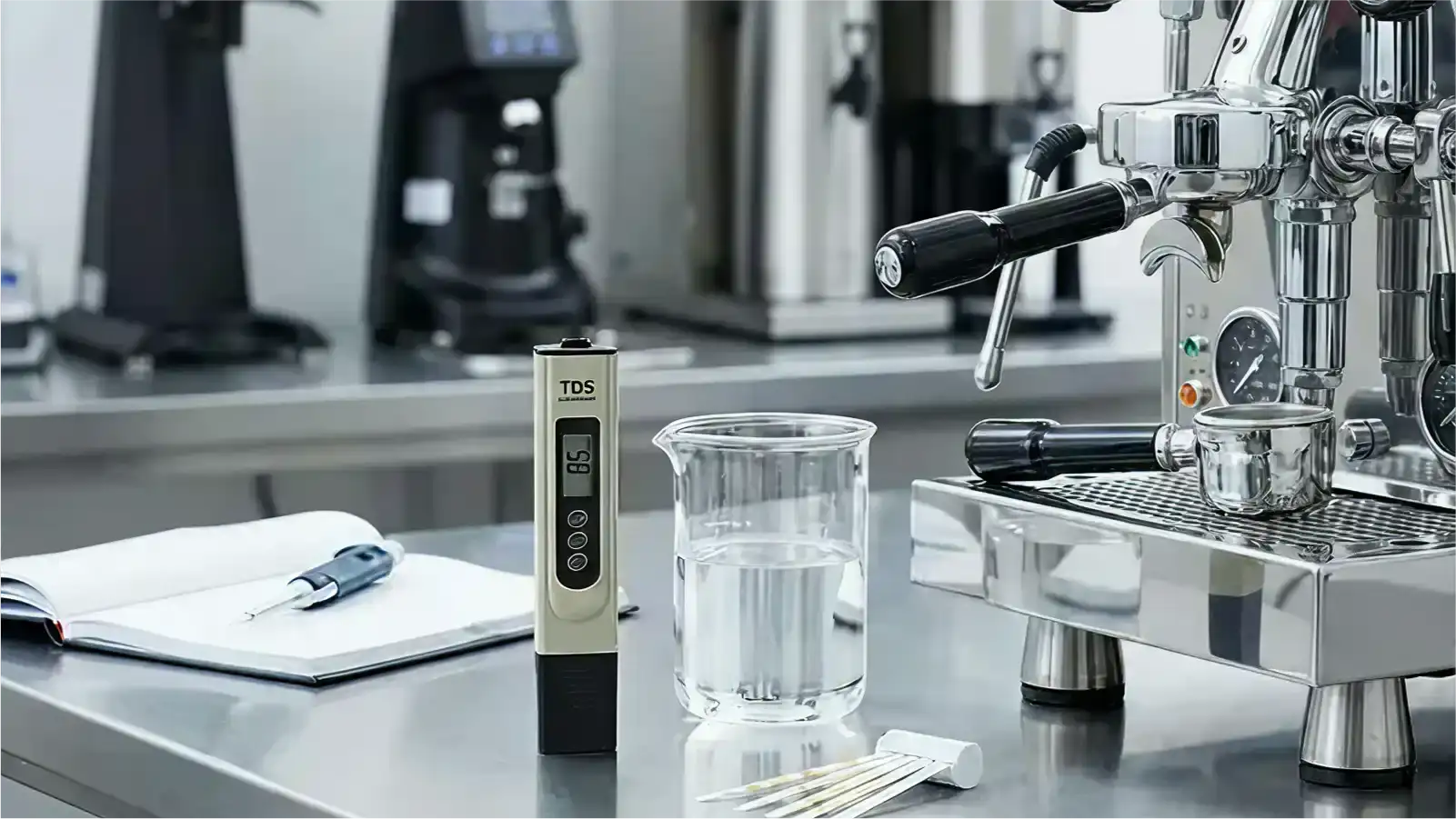
Espresso is 98% water. It is the primary ingredient in every cup you serve, yet it is often the most overlooked variable in a café’s setup.
If your water chemistry is off, two things happen: your coffee tastes unbalanced, and your expensive equipment begins to fail.
This guide breaks down the factual science of water quality, how to test it yourself, and what your results actually mean for your business.
The Chemistry: Scale vs. Corrosion
Water quality isn’t just about purity; it’s about balance. Commercial espresso machines require a specific mineral content to function correctly and extract good flavour.
1. The Risk of Hard Water (Scale)
“Hard” water contains high levels of dissolved minerals, primarily calcium and magnesium. When this water is heated in your boiler, these minerals precipitate out of the liquid and form solid limescale.
- Insulation: Scale coats heating elements, forcing them to work harder and use more energy to heat water.
- Blockage: Scale builds up in narrow pipes and flow restrictors (often 0.6mm wide), leading to inconsistent flow rates and eventual blockage.
- Valve Failure: Scale deposits can prevent solenoid valves from closing properly, causing leaks.
2. The Risk of Soft Water (Corrosion)
You might think the solution is to remove all minerals (like with distilled water), but that creates a new problem: corrosion.
Water with very low mineral content (low TDS) is aggressive looking for ions to stabilize itself. It will leech metals from copper boilers and brass fittings, leading to pinhole leaks and irreversible equipment damage.
DIY Water Testing: How to Do It Yourself
You don’t need a degree in chemistry to monitor your water. In fact, we recommend every café owner own a basic water testing kit.
Step 1: Get the Right Tool
Avoid paper test strips. They are difficult to read and offer only a vague approximation.
Instead, purchase a Drop Titration Kit. Brands like Hach, API, or Lamotte make affordable kits available online or at aquarium supply stores. These kits work by adding reagent drops to a water sample until the colour changes. The number of drops corresponds to the hardness level (e.g., 1 drop = 17 ppm or 1 grain per gallon).
Step 2: Measure Total Hardness (GH)
Total Hardness measures the total concentration of calcium and magnesium ions. This is your primary indicator for scale potential.
- Target Range: 50 - 150 ppm
- If > 150 ppm: High risk of scale. You need a softener.
- If < 35 ppm: High risk of corrosion. You may need to remineralize.
Step 3: Measure Alkalinity (KH)
Carbonate Hardness, or Alkalinity, measures the water’s ability to neutralize acid (its “buffer” capacity). This stabilizes pH and plays a huge role in espresso acidity.
- Target Range: 40 - 75 ppm
- If < 40 ppm: Your espresso may taste sour/acidic, and your machine is at risk of corrosion.
Step 4: Check for Chlorides
Chlorides (found in salts) are the enemy of stainless steel. Even in small amounts (>30 ppm), chlorides can cause pitting corrosion in stainless steel boilers. Most standard filters do not remove chlorides; only Reverse Osmosis (RO) systems can effectively handle them.
Interpreting Your Results
Once you have your numbers, compare them to the industry standards set by the Specialty Coffee Association (SCA).
| Parameter | Recommended Target | The Reality |
|---|---|---|
| Total Hardness | 50 - 175 ppm | > 150 ppm requires softening to prevent scale. |
| Alkalinity | 40 - 75 ppm | Buffers acidity. Too low = sour coffee + corrosion risk. |
| pH | 6.5 - 7.5 | Neutral is best. |
| Chlorides | < 30 ppm | Critical for stainless steel boiler longevity. |
Filtration Solutions
Based on your test results, here are the standard solutions available:
1. Carbon Filtration (Taste & Odour)
- What it does: Removes chlorine, sediment, and bad tastes.
- What it doesn’t do: It does not soften water or remove minerals.
- Use when: Your water hardness is already in the ideal range (rare in most cities).
2. Ion Exchange Softening
- What it does: Replaces calcium/magnesium ions with sodium (or hydrogen) ions.
- Use when: Your Total Hardness is high, but chlorides are low. This is the most common commercial solution for hard water areas.
- Note: We recommend “Hydrogen exchange” or sophisticated blend valves (like the Everpure Claris Ultra) to prevent water from becoming too acidic or too soft.
3. Reverse Osmosis (RO)
- What it does: Strips water of nearly all minerals and contaminants, then blends some filtered water back in (or remineralizes) to reach the target TDS.
- Use when: You have extremely hard water or high chloride levels that standard softeners cannot handle.
Determining Your Next Step
Water quality varies by municipality and season. We recommend testing your own water every 3-4 months to ensure your filtration system is doing its job.
If your results are consistently out of range, or if you are unsure which filtration system matches your machine’s flow rate, we are here to help. Our team can interpret your test results and recommend a solution tailored to your specific equipment and local water conditions.
Need help interpreting your water test? Contact us for a professional assessment.
Technical Takeaway
Water quality is the single biggest factor in machine longevity. Routine testing with a drop titration kit allows you to catch scale-forming or corrosive conditions before they cause expensive damage.
Liam
Chief Product OfficerLiam leads product design and service-to-market alignment at Complete Coffee Solutions, scouting for customer needs and helping cafes and businesses make key strategic decisions. With over 12 years in the specialty coffee industry, he brings together digital design, marketing, and deep espresso expertise to keep our offerings tasty.